Capstone Project Case Study: MindPath

Context
Mind Path began with a simple but maybe kind of strange question: how could I make a topic like moral philosophy be more accessible? The subject is often seen as abstract, academic, or difficult to connect with.

At first, I struggled to define the question itself. It felt like I had jumped into a complex idea without a clear starting point.

As I dug deeper into this topic, I realized the challenge was not about simply simplifying it. The real task was translating it into something approachable and interactive, avoiding unnecessary complexity.

That’s when I came across an article that really shaped the concept I wanted to make.

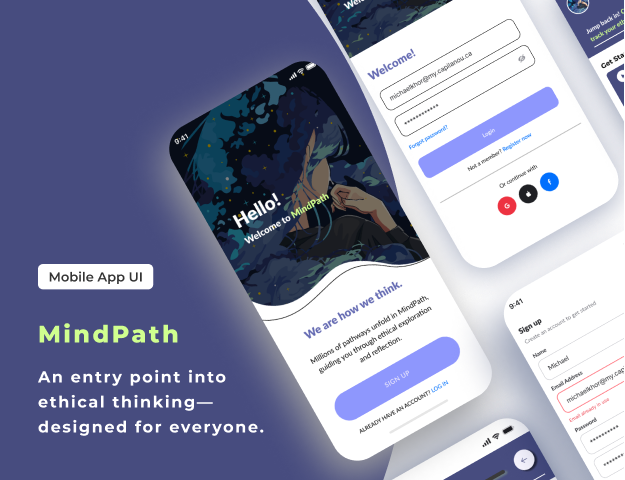
Mobile app UI for MindPath showing welcome screen, login form, and sign-up form emphasizing ethical thinking and accessible design.
Defining the Approach
I came across the work of Naomi Reshotko, a philosopher and professor at the University of Denver. I had been looking for an idea on how to translate moral philosophy into something accessible, and her work provided exactly that, shaping the concept I wanted to create.
Naomi Reshotko's Approach to Ethical Decision-Making
Reshotko’s approach emphasizes that moral reasoning is not about memorizing theories or finding the “right” answer. Instead, it is about thinking critically, exploring different perspectives, and reflecting on our own values and the impact of our choices.
This insight became the foundation for the mobile application concept I wanted to build for my capstone project.
Here is an example of this:
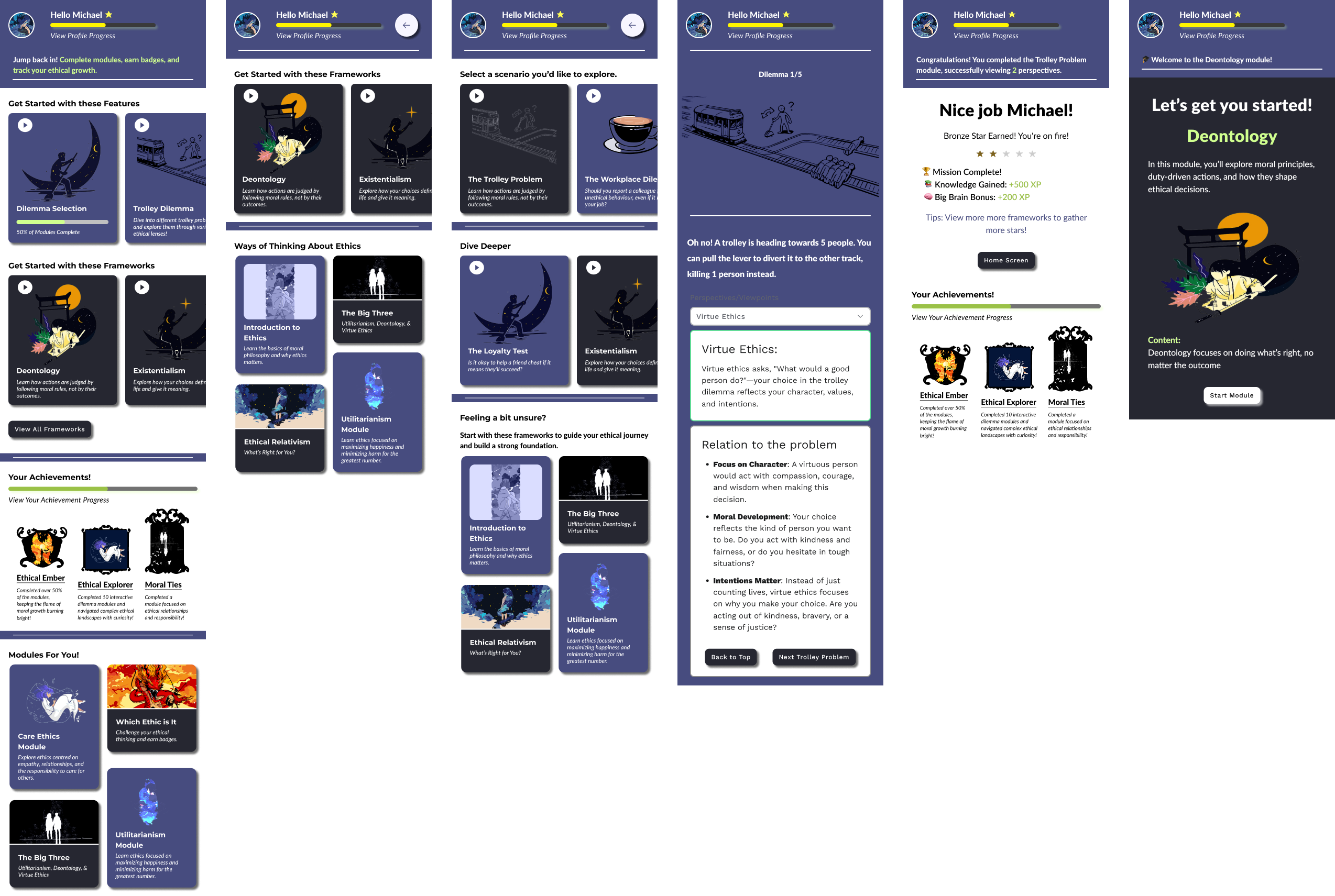
In my app, users encounter a variation of a dilemma (The Trolley Problem) and are encouraged to explore it through different ethical lenses, such as Virtue Ethics or Deontology, to see how each perspective influences the outcome.
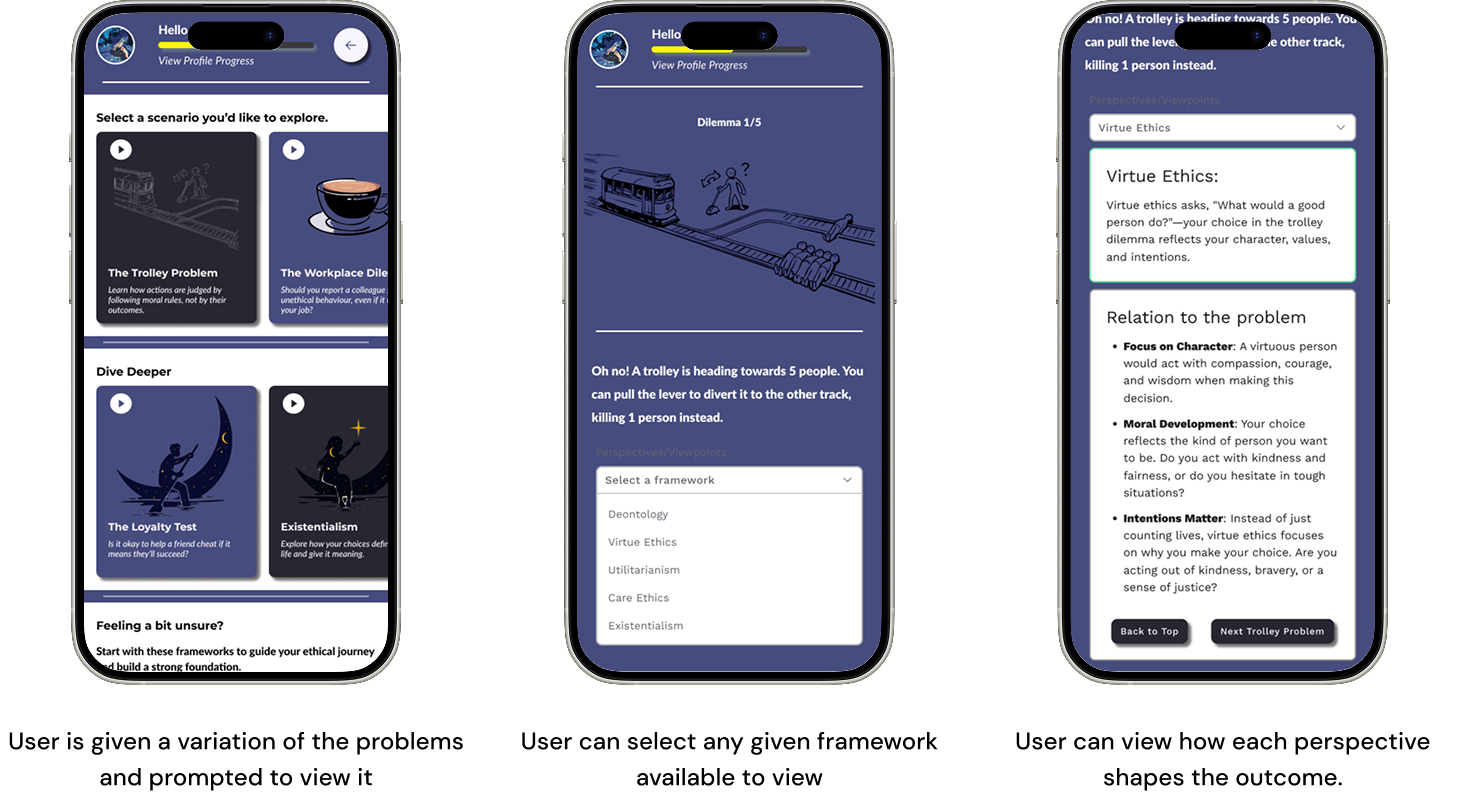
Three smartphone screens showing a moral dilemma app: first screen with scenario options including The Trolley Problem and workplace ethics, second screen with a trolley problem illustration and framework selector, third screen displaying Virtue Ethics explanation and relation to the trolley problem with navigation buttons.
Click to view prototype
Key Features
I wanted the app to let users explore ethical dilemmas without predefined "right" or "wrong" answers. By applying frameworks like virtue ethics and consequentialism, users see how perspectives shape decisions. Tailored feedback and an achievement system track progress and encourage self-reflection.
Interactive Ethical Dilemmas
Users make choices in complex scenarios, exploring the gray areas of ethics instead of being told what’s "right" or "wrong."
Multiple Ethical Perspectives
Decisions are viewed through frameworks like virtue ethics and consequentialism, showing different perspectives.
Guided Reflection & Meaningful Feedback
The app provides tailored feedback based on ethical theories, showing how different frameworks align or clash with users' decisions.
Interactive Achievement & Identity System
The app features a reward system that evolves over time, earning users badges and titles based on their decisions and progress.
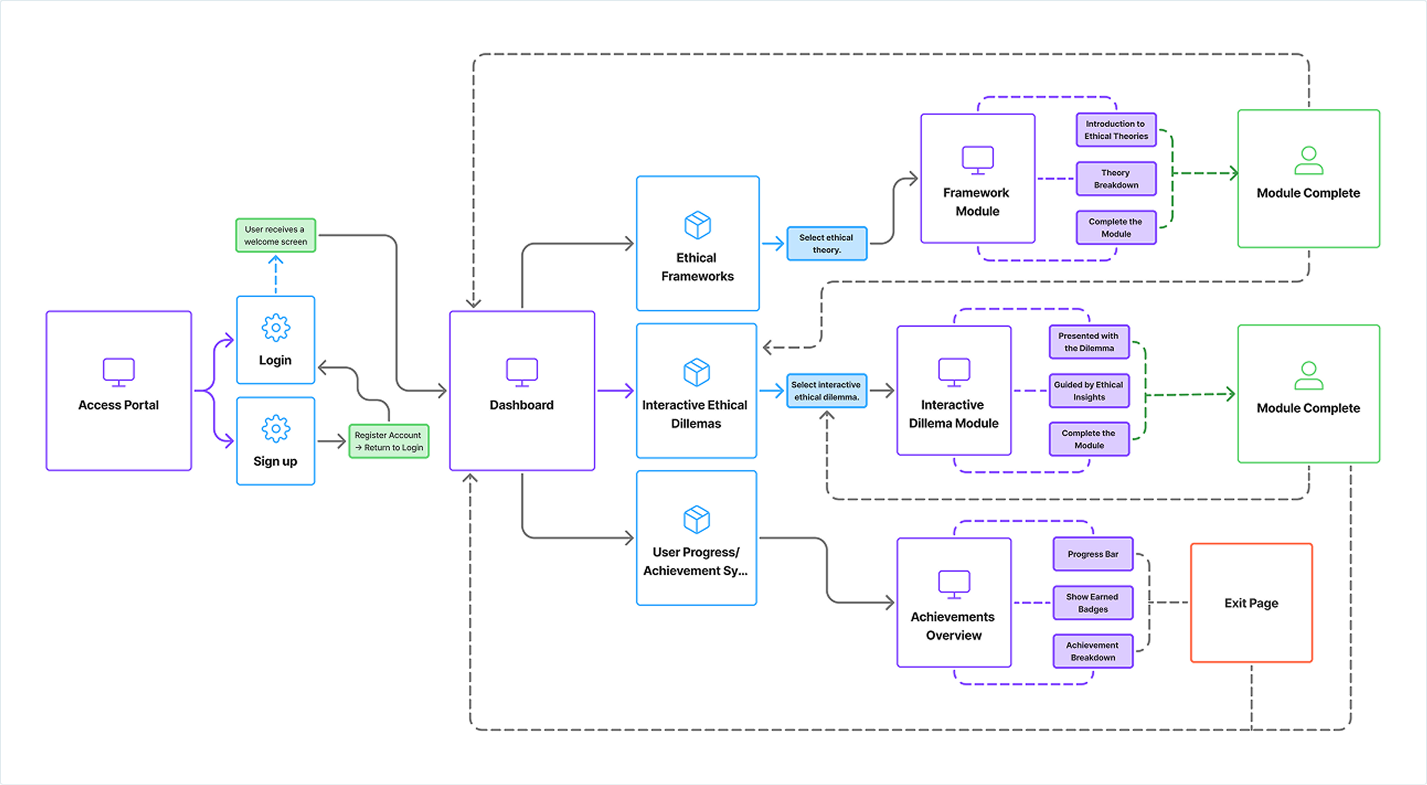
Below you can see the user flow chart of my prototype.
Flowchart depicting user journey from Access Portal to Login or Sign Up, then Dashboard leading to Ethical Frameworks, Interactive Ethical Dilemmas, and User Progress modules, each connecting to their respective detailed modules and ending in Module Complete or Exit Page.

Early Stages
Throughout the development of this project, I encountered several challenges that required creative solutions and iteration.

Balancing Simplicity and Depth
Simplifying complex theories while maintaining depth. I used interactive storytelling and bite-sized content to keep it engaging.

Ensuring Replayability and Engagement
The reward system initially felt too simple. I improved it with dynamic challenges tailored to user behavior, boosting long-term engagement.

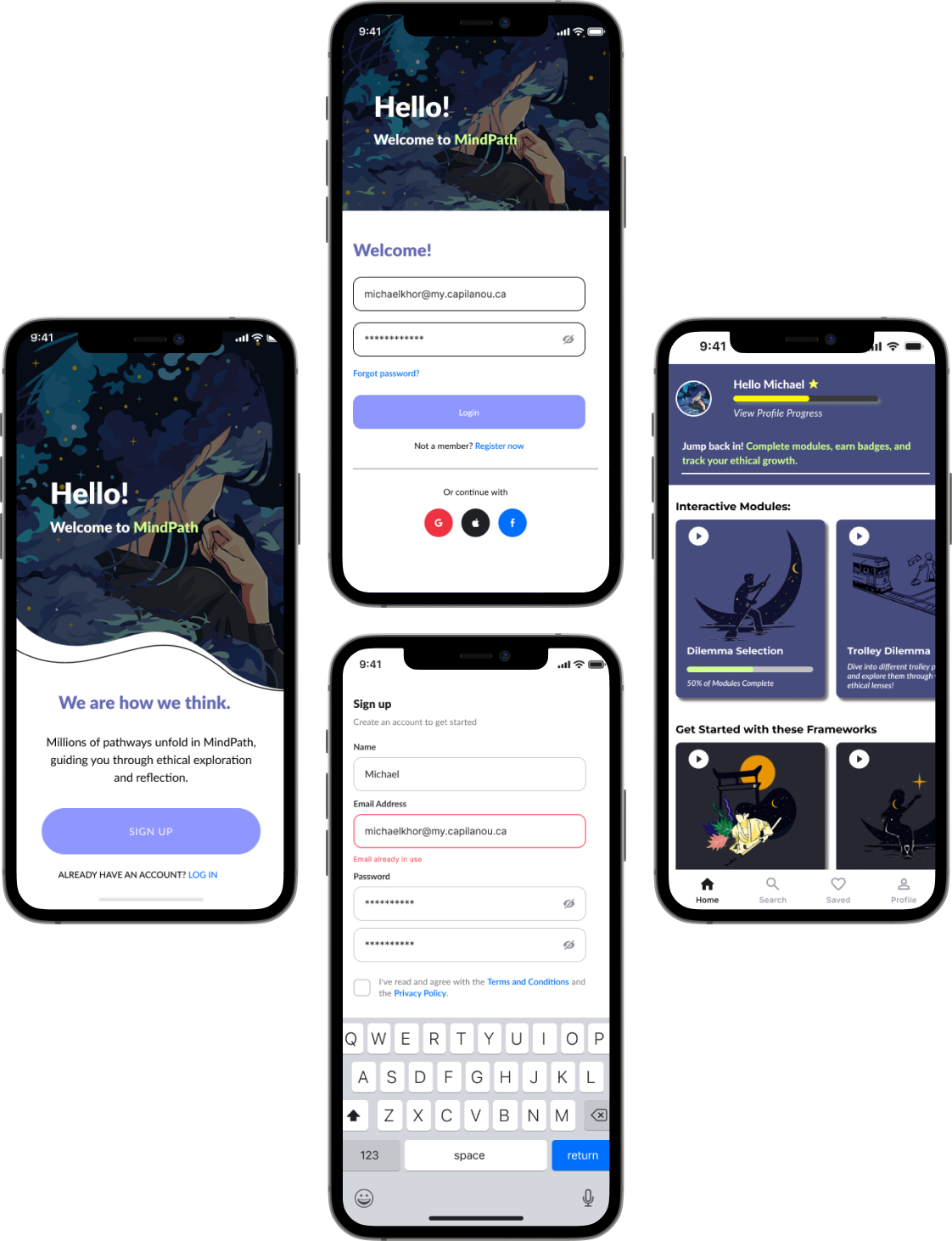
Four smartphone screens showing MindPath app with welcome screen, login, signup with email error, and user dashboard with interactive modules.

Below you can see the high fidelity prototype of the application. (not including the access portal)

User Testing & Data Visualization

Pre-Survey
To understand how people navigate ethical challenges, I will begin with a pre-survey to assess users current moral reasoning and familiarity with ethical frameworks. This will establish a baseline for how users approach dilemmas before using the app.

App Engagement
Afterward, users will engage with the app, applying various ethical perspectives to real-world scenarios.

Post-Survey
Following the app experience, a post-survey will measure changes in their understanding, confidence, and approach to ethical reasoning. By comparing the pre- and post-surveys, I can evaluate the app's effectiveness in enhancing users' critical thinking, perspective-taking, and ethical reasoning skills.
Click to view prototype
Data Visualization
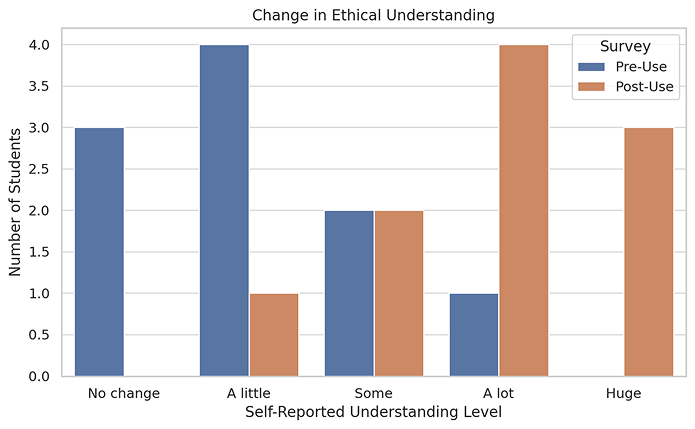
Survey data from 10 participants showed that most felt more confident in their ethical thinking after using the app. Before starting, only a few were familiar with ethical theories, but by the end, 70% reported a clear shift in how they understood and approached moral dilemmas.

When comparing learning styles, most students said the interactive format made ethics easier to grasp than just reading about it. Overall, the results suggest the app helped make a complex topic feel more real and engaging.
Bar chart comparing pre-use and post-use self-reported ethical understanding levels of students, showing increased understanding post-use, especially in 'A lot' and 'Huge' categories.
Final Outcome & Key Learnings
The final prototype is a scenario-based learning app that helps users explore real-world ethical dilemmas without presenting “right” or “wrong” answers. It encourages reflection through personalized feedback based on ethical theories like consequentialism, virtue ethics, deontology, and care ethics. A simple reward system motivates users and tracks their growth over time.

This project taught me how to balance complexity with accessibility. Turning dense theories into bite-sized, scenario-based experiences was challenging, but user feedback showed the app made ethics approachable, engaging, and thought-provoking.